
 COACHING RUNNERS
THROUGH EVERY SEASON ·
THE TRIANGLE, NC & WORLDWIDE
 COACHING RUNNERS
With the changing of the seasons comes challenges for runners regardless of what your favorite temperatures to run are. As the chill of winter fades and spring settles in, runners often find themselves adjusting to a new rhythm of training. One day can have a 20-30 degree temperature variation, and depending on your geographic location, humidity adds an additional obstacle.
Before you start questioning your fitness, remind yourself that your body needs time to adapt. Think of our body like a battery when it comes to heat acclimation! We’re not going to be fully charged after just one run. We need time… and that requires some patience, especially if the temperatures fluctuate.

Spring offers an energizing backdrop of blooming landscapes and longer daylight hours!
What do we mean by adjusting?
Spring is a time of growth and rediscovery, and for some runners that can be a reset of goals and discovering the beauty and joy of outdoor running again after a winter of chilly cold runs or treadmill adventures.
Keep reading to hear our six simple adjustments that you can make as the temperatures rise this spring season. We even made a handy visual below for you to save and refer back to!
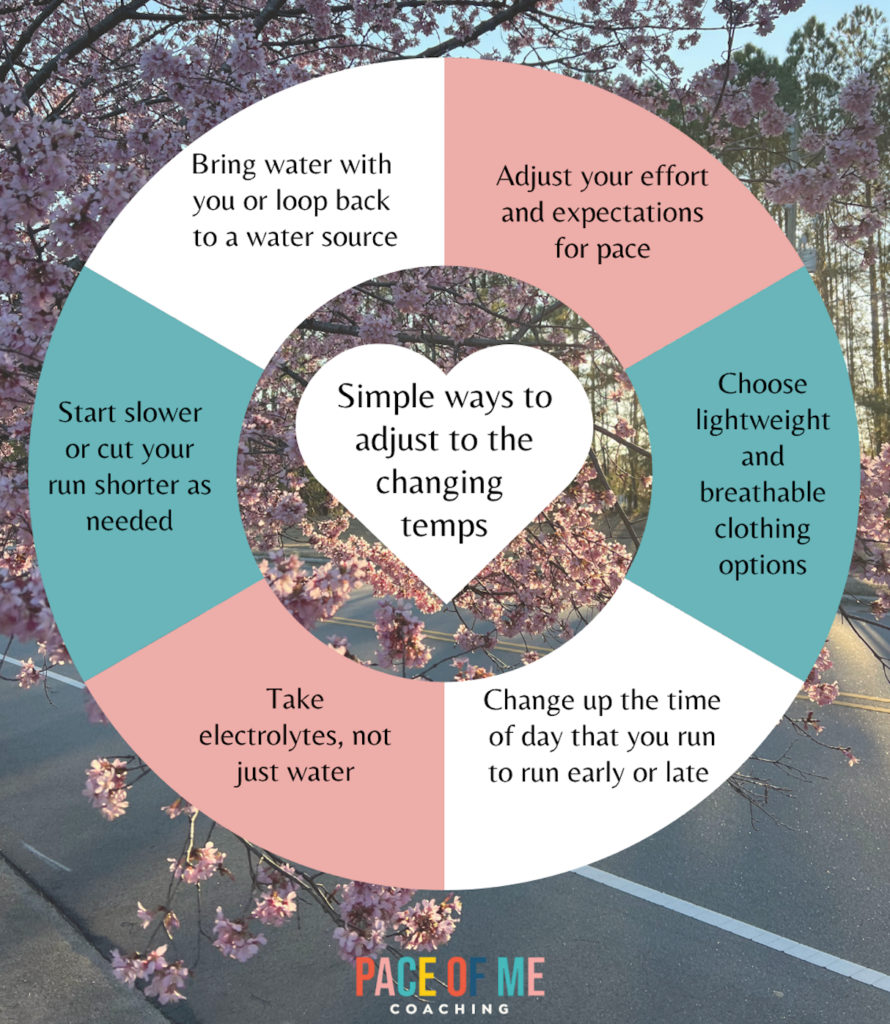
Knowing that you are close to a source of water on a spring run that gets warmer than what you’re used to can make a difference in how you feel and perform. Your body loses fluids faster through sweat, something we often overlook in the winter when we’re cooler. Allowing yourself the peace of mind to have water nearby can help your run feel steady and controlled.
Tip! Some cities turn off their public water sources in the winter and don’t turn them back on as early as we runners wish they did, so being prepared with your own water can solve this.

Your breathing may quicken, your heart rate may rise quicker than it typically does, and your pace may look all over the place. Don’t panic! All of these factor into how your body is responding to heat and seasonal change. In warmer temperatures, your body has to work harder to regulate internal heat, even with only a mild increase in core temperature. Thermoregulation is where your body diverts energy towards cooling (sweating) rather than performance. Perceived effort is higher and recovery may take longer. Safely going off of effort over pace is important and know that you haven’t “lost” fitness. We promise.

Rate of Perceived Exertion (RPE) is a 1-10 scale used to measure how hard your body is working during physical activity. It takes pace out of the equation and can be helpful as a check-in during these warmer spring runs.
It’s all about adaptability! Choosing lightweight and breathable clothing options will allow your body to cool more efficiently, helping release heat instead of trapping it. If you’re running in the cooler, earlier hours of the day or evening, it may help having a light over layer. You can always shed layers as you warm up into the run, but you don’t want to overheat!

This can be a great way to avoid the heat of mid-day. If your schedule allows you to run earlier in the morning or evening, you might appreciate it. Your body doesn’t have to work as hard to stay cool and you’re at a lower risk of over-heating. The sun is less intense, which reduces UV exposure and the chance of sunburn. Cooler air will feel easier to breathe, making it feel like you can perform stronger as you acclimate. Those feelings we talked about earlier about feeling like you’ve lost fitness running in the warmer temps… these chances to run at different times of day help ease you into late spring and summer.

During warmer runs, your body loses more than just water. You also lose electrolytes through your sweat. Replenishing with solely water can leave you out of balance. Electrolytes matter! They keep your fluid balance stable and are essential for muscle contractions. When our electrolyte levels drop, this is when we start to feel cramps, weakness and that sluggish, heavy feeling in our legs. We sweat more in warmer temperatures, therefore we lose more electrolytes. If we drink lots of water without electrolytes, we’re at risk for hyponatremia, where our blood’s sodium levels can become too diluted, leading to nausea, headaches, and confusion. In warm spring (and then summer) conditions, electrolytes help your body actually use the water you drink and keep everything functioning smoothly. That’s a win in our minds!

Check in with your body, you know yourself best. Ease into your run and be okay with making adjustments. Some modifications that can be helpful (and one’s we often provide for our athletes during warm stretches or heat waves) are taking out hard effort segments and focusing on duration or time on feet. This allows you to safely cover the mileage and swaps out the intensity from handling the pace-pushing for your body’s ability to better focus on regulating body temperature. Another modification can be shortening the run (and mentally accepting that this is not considered a bad thing). Your body is still working harder in a shorter run adjusting to the heat and you’re more likely to recover faster, avoiding over-heating. If keeping the number of miles is important to you, consider splitting your run up over the course of the day. Remember, honoring your body during this seasonal change can make a huge difference in the long run!
Be proud of the effort you are putting in. Seasonal changes can alter how running “feels” but stay confident that all that winter training was worth it.