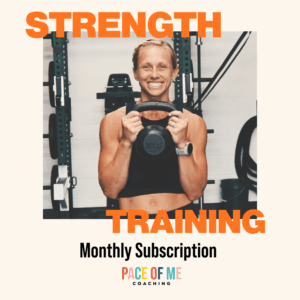
Strength training is an essential part of your run training, and strength training that’s expertly designed to support your running not only makes you a more powerful athlete but also helps you build resilience and resistance to injury! Pace of Me strength training is a progression overload program, meaning the same exercises will be repeated for four weeks with increased gradual intensity (more reps, sets, weights, etc). Progressive overloading is a great way to build strength by causing your muscles to adapt to changes over time. This programming is available to you as a monthly subscription!
Once you have processed your first monthly payment, Coach Steph will send you an invitation to the SuperSet app so you can create your account and get started. Our programs run every four weeks, so if you join in the middle of a program, please begin with Week 1 of that phase. Then when the next phase starts you will begin with the new Phase 1 with the rest of the group. Pace of Me Strength is a progressive overload program, which means you will do the same workouts for three weeks while gradually increasing intensity (more sets, reps, weight, etc) and then the fourth week will be a de-load week. You can do these workouts from home or at the gym. If you have questions or need help, you can contact Coach Steph within the app or email her at steph@paceofme.com.
Can I do these workouts from home? What equipment do I need?
It is important to us that you are able to do these workouts from home or at the gym, so we try to limit the amount of equipment needed! Ideally you will have access to 1-2 sets of dumbbells, 1-2 kettlebells, a medicine ball, resistance bands, a step or bench and gliding discs/sliders (paper plates or socks will work too!).
What do I do if there are exercises in the programming I need to avoid because of injury or specific imbalances in my body?
If an exercise aggravates pain, or if you’ve been told to avoid it, you can substitute a movement with the same purpose but lower risk. For example, if lunges bother your knees/hips, it’s okay to do step ups or glute bridges instead. If you see an exercise that you need to modify/change, please email Steph and she will provide other options for you that will allow you to still achieve the training goal.
How do I know how much to increase the weight as I progress and get stronger?
As runners, we should progress gradually. If you consistently finish with more than 2-3 reps left in you, the weight is too light and it’s time to increase. Typically you can increase upper body weight by +2.5-5lb and lower body by 5-10lbs. If using a kettlebell, it’s okay to move up one size (example – 12kg to 14kg). If your form begins to change or you reach failure before given sets, you went too heavy.
How do I modify or adjust my strength programming for race week?
Race week is obviously very important and we do not want to jeopardize race day with too much strength. The week before your goal race, it’s okay to continue lifting but decrease your volume by 50%. Example, drop to 2 sets of work and cut the number of reps in half. For race week, keep your last lift 4-5 days out from race day. Do not add in anything new and focus on mobility, activation, and light power. Goal should be to keep sharpness in your legs but you do not want to cause fatigue. Think 1-2 sets with fewer reps (3-5) at 50-60% of your normal weight.
What do I do if I get sick or injured and miss workouts?
If you miss workouts due to being sick, do not jump back into full strength on your first workout back. Do one easier session with 50-60% of normal weight with 1-2 sets instead of 3-4. Missing 1-2 workouts will not cause any measurable strength loss. If you miss more than 1-2 workouts due to injury, do not try to start back where you ended as you may increase your chance of reinjury. Return by using lighter weights and fewer sets to make sure you continue to be pain free. You can continue to add in 10-20% more weight each week as tolerated but stop if you feel any pain during or after your lift.
How many days should I put between my strength training sessions each week?
For most runners, 1-2 days in between each strength training session is ideal. If you are strength training while training for a race, it’s okay to put 2-3 days in between each lift.
Should I do my strength workouts on the same days as my long runs or speed workouts?
As the saying goes “keep hard days hard.” By lifting on the same day as your long run or speed workout, you are allowing your easy days to be truly easy and give your body a chance to recover. However! That may not always work for everyone. Some people may find that lifting and doing workouts on the same day may cause too much stress on their bodies, leaving them sore and tired for days. Others may also just not have enough time in the day to do both. If you can’t lift on the same day as your long run or workout, try and lift 2 days before a hard session or the day after a hard session.
If I am running and doing strength on the same day, which one is better for me to do first?
It is typically better for runners to lift after they go out for a run to help protect the quality of the run. If you lift first, you may cause too much fatigue in your legs which may affect your running form.
If I am sore after a strength workout, is that okay or should I not run again until the soreness goes away?
It is okay to run if you are sore after a strength workout, as long as it’s soreness and not pain. Running at an easy pace can actually help to reduce soreness by increasing blood flow. However, please stop if you feel pain and things feel worse as the run goes on.